Where are our relationships going?
This has been rolling around in my brain for a while now as I hear, see and read about how people have been losing their interpersonal skills in social environments and the workplace.
People are socially anxious, checked out, disengaged, disempowered, have lost trust in leadership and many are burnt out, turning up to work because they have to.
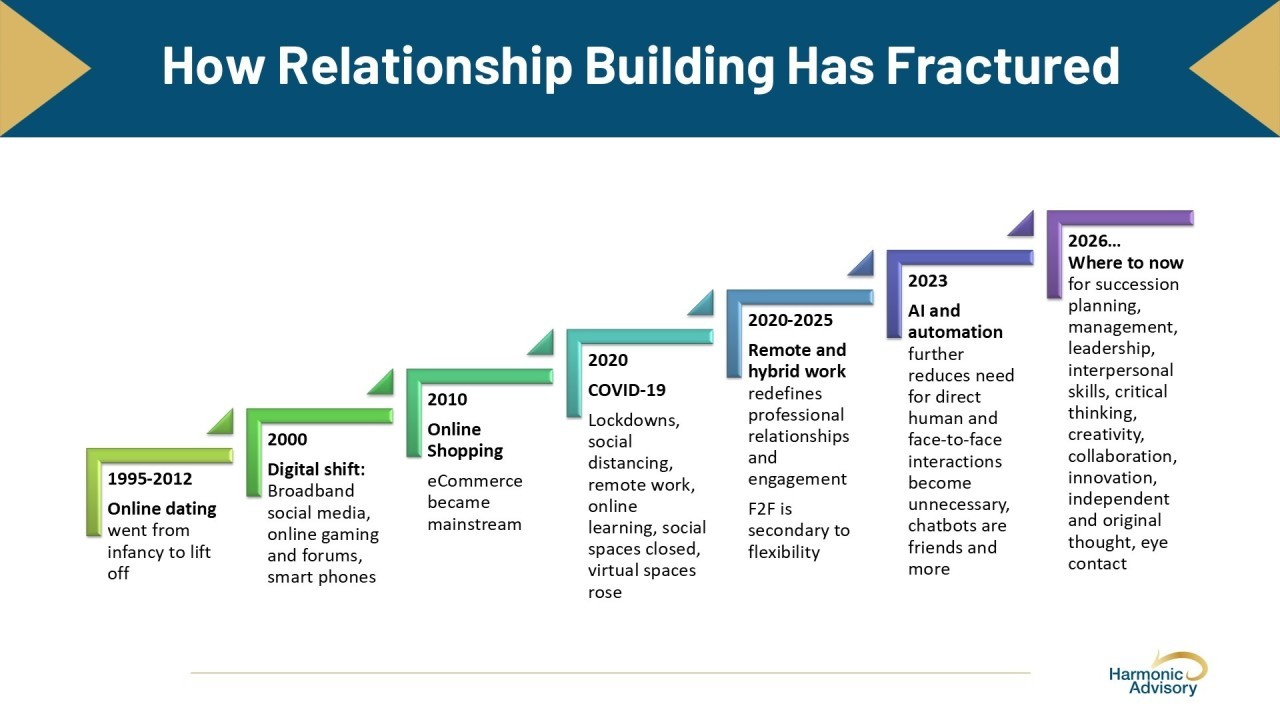
A number of major social, technological, economic and health events have contributed to the decline in our ability and inclination to interact with each other, and digital-first interactions have become increasingly the norm.
1995-2012 – Online dating: Infancy to lift off
2000 – Digital shift: Broadband expansion, social media, online gaming and forums, smart phones
2010 – Online Shopping: eCommerce became mainstream
2020-2022 – COVID-19: Lockdowns, social distancing, remote work, online learning, social spaces closed, virtual spaces rose
2020-2025 – Remote and hybrid work redefined professional relationships and engagement, F2F is secondary to flexibility
2023 – AI and automation: Direct human and face-to-face interactions become increasingly unnecessary, chatbots are friends and more…
2026… Where to now: Succession planning, management, leadership, interpersonal skills, critical thinking, creativity, collaboration, innovation, independent and original thought, eye contact
- By 2022, 30% of US adults had used a dating site or app
- Today, 68.7% of the global population is using social media for over 2 hours a day
- They spend a further hour on Netflix and the like
- The first professional introduction typically happens online – people are vetted first
This disconnection from the real world has impacted not only our workplaces but our young people – some of whom have completed corporate traineeships in a predominantly WFH capacity!
I hear from and talk to many people frustrated and worried about the future of workplaces, communities and social structures, and the ability of people to think critically, to listen, converse, learn and innovate.
They’re wondering where our next leaders are coming from.
Relationships are predominantly transactional and many people don’t know how to build stronger, mutually beneficial connections, business friends, people you can reach out to with an idea, question or request.
Many leaders are actively trying to develop personal connections across their teams, to gather people so they can get to know each other better, but their efforts are being met with rejection.
Pizza and sushi nights don’t work, young people drink less so pub nights don’t appeal, the office is empty at 5pm – or in some cases, both Monday and Friday and then every day at 4pm.
So what can be done?
I’ve been thinking about this too.
We need to think differently. Solutions are bespoke and personalised, not rote or automated, not what worked in the past and what might have been easy.
We need to tap into hearts and minds, overcome fear to understand the issues, design activities, events and opportunities that people really care about and we need to create safe spaces for people to air ideas without being shouted down, alienated or ghosted.
We need to create more ways for people to learn in person, to take out the excess content and encourage more free discussion.
We also need to put ideas into action, to test and iterate, learn and develop.
It needs to be fun.
It actually used to be fun – not constant cost cutting, headcount reductions, watching people’s keyboards, toxic cultures. Lifelong friendships were built at work and these environments were intellectually stimulating.
Emerging Trends
In America at the moment, people are craving connection. So much so there are book reading groups with six week waitlists. That is, people gathering in small groups in public spaces, eating a snack and and quietly reading a book.
Social media use is starting to fall as people don’t trust things that seem almost too real and start to realise real-life experiences matter.
It’s up to leaders to find effective ways to cut through the noise of oversaturated social media feeds and AI slop and give people better reasons to connect.
A group of CMOs have said if they had $1 million they would spend every last cent on real-life experiences:
Creating incredible spaces to connect frequently with the top 20 percent of people who really move the needle for your business. Host intimate dinners, gatherings and events that truly deepen those relationships and build professional friendships. The ROI of trust and loyalty built in those rooms far outpaces what you’ll get from a broad but shallow spend on ads.
“In the age of AI – when it’s hard to tell which messages come from humans and which don’t -nothing cuts through like a real relationship, face-to-face.” Jenny Nguyen
You can read the article here: Founders and CEOs reveal their dream strategies to give their businesses a boost
What do you think? What else would you do?
Are you thinking about the skill gap and planning for this?
Nina
If you found this article interesting or valuable, please share it with others.